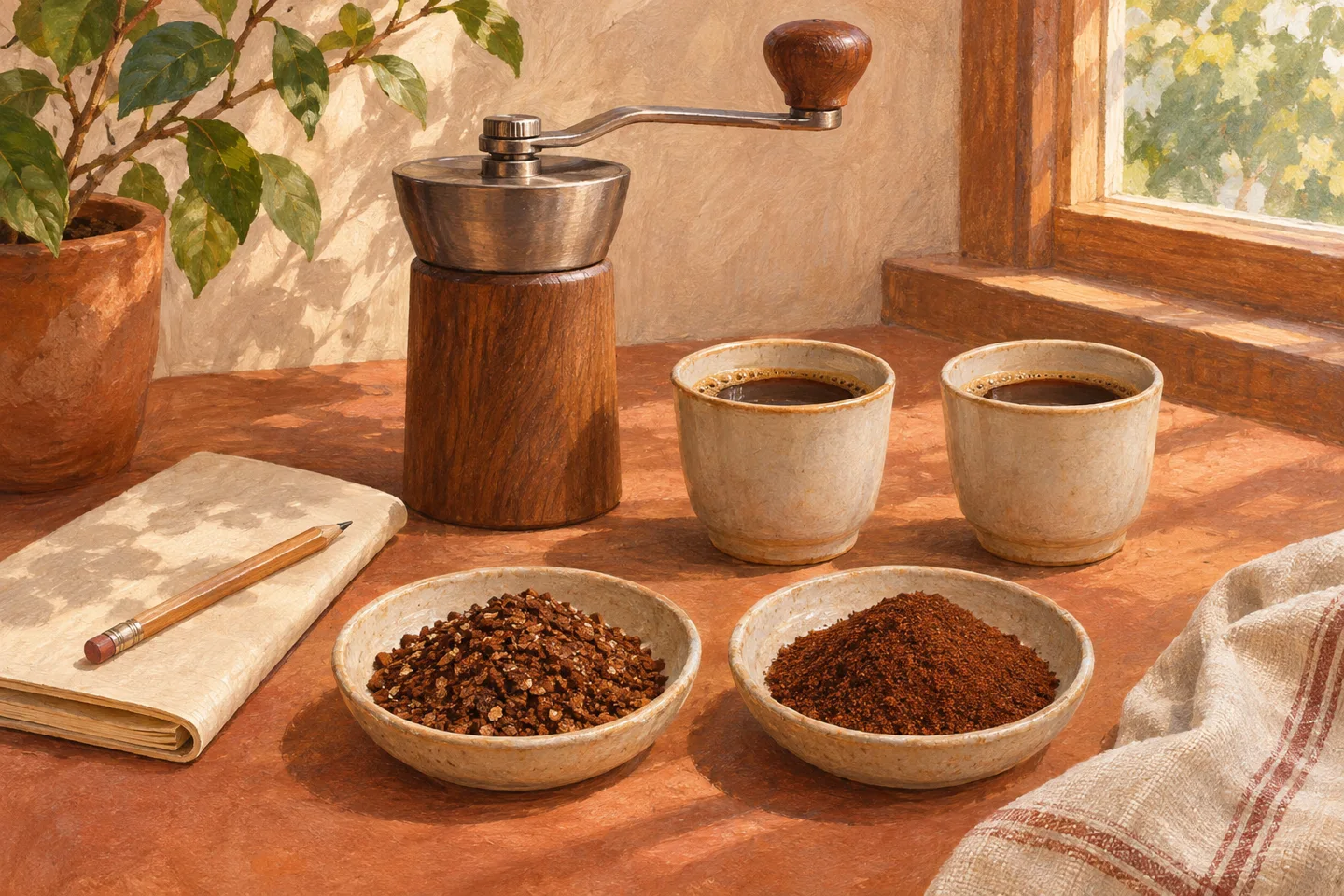
A setting is a starting point, not a score
If you like the beans but not the cup, start with a small question: what happens if only the grind changes? This guide helps you notice differences rather than prescribing a correct taste. It is an editorial practice suggestion, not an equipment test we performed. Use your existing grinder and brewing method, and follow the manufacturer’s instructions when adjusting it.
What physically changes
Barista Hustle explains that smaller particles expose more surface to water, so grind size affects extraction speed. This explains the adjustment; it does not promise that finer coffee tastes better.
Why the brewing method matters
A 2021 UC Davis study found that grind size did not change final beverage concentration at equilibrium in its immersion experiments. This was not an espresso experiment. We therefore do not generalize its result to every brewing method.
A home comparison: two brews, one change
Our suggestion: choose a filter recipe you already know. For the first brew, record coffee and water weights, grinder setting, water temperature and preparation time. For the second, use the same beans and quantities and make one small grinder adjustment according to its instructions. Keep pouring and procedure as similar as possible. Record the resulting time without trying to correct it through another change. Taste only once both drinks are comfortably cool. If the difference is unclear, repeat another day; two cups need not settle the question.
What to note and what to ask at a café
Instead of only good or bad, ask three questions: which cup is more enjoyable, what changed in body, and what remains after a sip? Add a sentence in your own words even without specialist vocabulary. If adding milk, try the same amount in each cup. Café operators could use this as a short team exercise: compare without deciding in advance which cup should win. As a guest, ask which brewing method the café suggests for those beans at home. You do not need a new grinder to start that conversation.